Quick Summary
- Who this guide is for: Filipino citizens, OFWs, and foreigners seeking PhilHealth membership or updates.
- Important Notes: Always prepare valid IDs and correct forms before proceeding.
- Estimated Time: 33 minutes for reading and preparation.
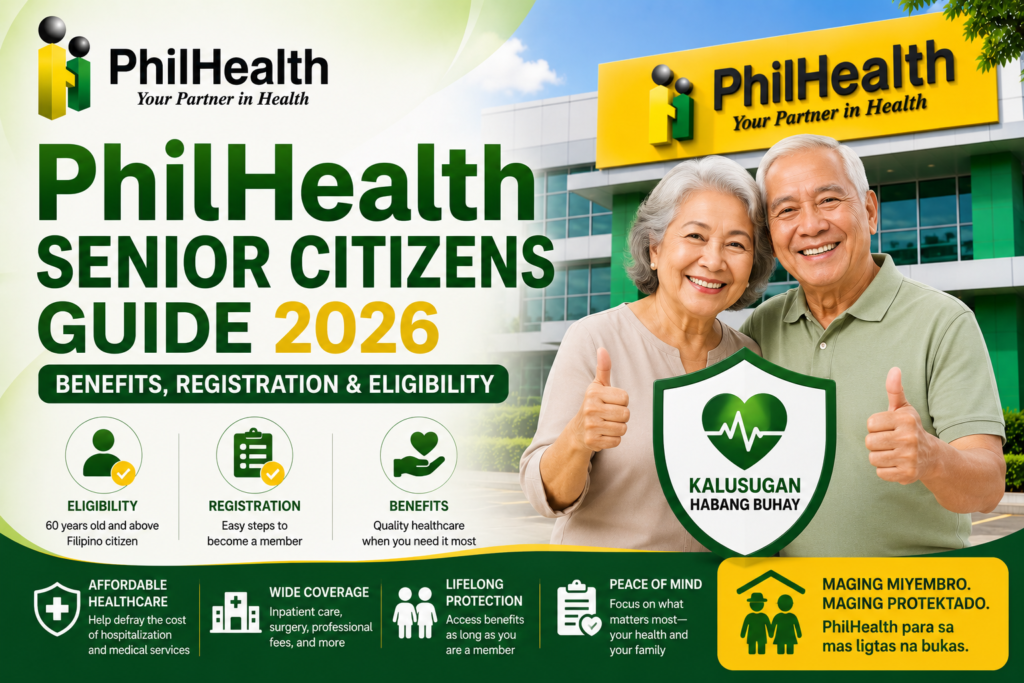
PhilHealth Senior Citizens Guide 2026: Complete Benefits, Automatic Coverage, Registration & Eligibility
What Is PhilHealth for Senior Citizens?
PhilHealth senior citizens coverage is the health insurance benefit provided by the Philippine Health Insurance Corporation specifically for Filipino citizens aged 60 and above. Under the Universal Health Care Act, senior citizens are classified as Indirect Contributors — meaning their health insurance premiums are fully paid by the national government. They do not need to make monthly or annual payments out of pocket. This coverage ensures that elderly Filipinos, who often face increased medical needs and reduced income, are not denied healthcare access due to financial constraints. The PhilHealth senior citizens program works alongside the benefits provided by the Expanded Senior Citizens Act, which grants the 20% senior citizen discount on hospital bills, medicines, and medical services. Together, these two government programs substantially reduce the financial burden of healthcare for elderly Filipinos and their families.
Who Qualifies as a PhilHealth Senior Citizen Member?
You qualify as a PhilHealth senior citizens member if you are a Filipino citizen aged 60 years or older. There are two pathways to qualification. First, if you were already a PhilHealth member before turning 60 — whether as an employed worker, self-employed individual, or voluntary member — you automatically transition to lifetime member status upon reaching age 60, provided you are no longer gainfully employed. Second, if you have never been registered with PhilHealth, you can enroll as a new senior citizen member at any time by presenting your Senior Citizen ID or OSCA ID. The qualification is based on age and citizenship, not on previous employment history or contribution record. Even a senior citizen who never worked in the formal sector is entitled to full PhilHealth coverage. The law recognizes that healthcare is a right for all elderly Filipinos, regardless of their economic history.
Automatic PhilHealth Coverage for Senior Citizens
One of the most significant provisions of the Universal Health Care Act is the automatic PhilHealth coverage for all senior citizens. This means that upon reaching the age of 60, every Filipino is entitled to lifetime PhilHealth membership without needing to apply, pay premiums, or meet contribution quotas — as long as they are not gainfully employed. If you were previously a paying member, your status automatically shifts to lifetime member. If you were never registered, you simply need to enroll once to activate your lifetime coverage. This automatic coverage eliminates the risk of elderly Filipinos falling through the cracks of the healthcare system. The government allocates funds annually to subsidize the premiums of all senior citizen members, ensuring that hospitals and clinics are compensated for the care they provide. The automatic coverage applies nationwide, regardless of whether the senior citizen lives in a city, municipality, or rural area.
Key Laws Governing Senior Citizen PhilHealth Coverage
Three major Philippine laws establish and protect the healthcare rights of PhilHealth senior citizens. Republic Act No. 11223, the Universal Health Care Act of 2019, mandates automatic PhilHealth membership for all Filipino citizens and classifies non-employed senior citizens as Indirect Contributors with fully subsidized premiums. Republic Act No. 7432, the original Senior Citizens Act, first established benefits and privileges for the elderly. Republic Act No. 9994, the Expanded Senior Citizens Act of 2010, strengthened these benefits by codifying the 20% discount on hospital bills, medicines, medical supplies, professional fees, and diagnostic procedures — and granting exemption from the 12% VAT on these purchases. Together, these laws create a dual-layer financial protection: PhilHealth pays a case rate deduction on your hospital bill, and on top of that, the remaining balance is subject to the 20% senior citizen discount. This legislative framework reflects the Philippine government’s commitment to protecting the health and dignity of its elderly population.
PhilHealth Membership Categories for Senior Citizens
PhilHealth senior citizens fall into one of several membership categories depending on their employment status and prior membership history. A Lifetime Member is a senior citizen aged 60 and above who is no longer employed and has met the qualifying contribution requirements (120 monthly contributions) prior to retirement — or is simply covered under the automatic lifetime provision. A Sponsored Member senior citizen is one whose premiums are paid by the government through national subsidy or local government unit sponsorship, typically for indigent elderly who were never part of the formal contributory system. An Employed Senior Citizen is one who, despite being 60 or older, continues to work — in this case, the employer continues to deduct and remit PhilHealth contributions just like any other employee. Understanding which category applies helps determine whether any action is needed to activate or maintain coverage. For most non-employed seniors, the coverage is automatic and premium-free.
Sponsored Members vs Lifetime Members: What’s the Difference?
| Feature | Lifetime Member | Sponsored Member (Senior) |
|---|---|---|
| Premium Payment | Fully subsidized by government | Fully subsidized by government |
| Previous Contributions | Usually has prior contribution history | May have no prior contribution history |
| Registration Path | Automatic transition from employed/voluntary | Enrolled through DSWD, LGU, or PhilHealth branch |
| Benefits | Full standard PhilHealth benefits | Full standard PhilHealth benefits |
| Senior Citizen Discount | Applies on top of PhilHealth deduction | Applies on top of PhilHealth deduction |
Eligibility Requirements for Senior Citizen PhilHealth Members
To be eligible for PhilHealth senior citizens coverage, you must meet three core requirements. First, you must be a Filipino citizen or a qualified resident alien who has been granted permanent residency. Second, you must be at least 60 years old. Third, if you are not gainfully employed, you are automatically entitled to premium-free lifetime coverage. If you are still employed at 60 or older, you remain classified as an employed member with contributions deducted from your salary. There is no income threshold for eligibility — even senior citizens with pensions, businesses, or other income sources who are not formally employed qualify for the subsidized coverage. The only documentation required to prove eligibility is your Senior Citizen ID issued by the Office of the Senior Citizens Affairs in your city or municipality, or your OSCA ID. If you do not yet have a Senior Citizen ID, you can apply for one at your local OSCA office, which is a prerequisite for PhilHealth registration.
Required Documents for Senior Citizen Registration and Claims
| Transaction | Required Documents |
|---|---|
| First-Time Registration | Senior Citizen ID or OSCA ID, valid government ID, completed PMRF |
| Membership Status Check | Senior Citizen ID, PhilHealth PIN (if available) |
| MDR Download | PhilHealth PIN, Member Portal login credentials |
| Hospital Claim Filing | PhilHealth ID or MDR, Senior Citizen ID, valid ID, signed Claim Form |
| Dependent Claim | Senior’s MDR, dependent’s ID, proof of relationship, Claim Form |
How to Register as a Senior Citizen PhilHealth Member
Step 1: Secure Your Senior Citizen ID
Visit your local Office of the Senior Citizens Affairs and apply for your Senior Citizen ID or OSCA ID. Bring a valid government ID and proof of age such as your birth certificate.
Step 2: Complete the PhilHealth Member Registration Form
Download and fill out the PMRF from the official PhilHealth website or obtain a copy at any PhilHealth branch. Indicate “Senior Citizen” or the appropriate membership category.
Step 3: Submit Your Registration
Visit the nearest PhilHealth branch with your completed PMRF, Senior Citizen ID, and one valid government ID. Many LGUs also facilitate bulk registration for senior citizens — check with your barangay or city hall.
Step 4: Receive Your PhilHealth PIN
Once processed, you will receive your permanent 12-digit PhilHealth Identification Number. This PIN is yours for life. Keep it in a safe place and share it with a trusted family member.
How to Activate Senior Citizen PhilHealth Membership
For many senior citizens who were previously employed, membership activation is automatic — your status transitions to lifetime member when your employment ends. However, if you have never been registered or your records show inactive status, activation requires a simple visit to a PhilHealth branch with your Senior Citizen ID and a valid government ID. The PhilHealth officer will update your record to reflect your lifetime member status. Once activated, you can immediately access your benefits. To verify activation, you or a family member can log into the PhilHealth Member Portal using your PIN and download your Member Data Record. The MDR will show your membership status as “Active” and your category as “Lifetime Member.” If it does not, follow up with PhilHealth to correct the record.
How Senior Citizens Can Check Their PhilHealth Membership Status
There are three ways to verify PhilHealth senior citizens membership status. The easiest is through the PhilHealth Member Portal — log in with your PIN and password, and your dashboard will display whether your status is Active, Inactive, or Lifetime. The second method is visiting any PhilHealth branch where an officer can check your status using your PIN or full name and birthdate. The third is to download your Member Data Record (MDR), which serves as the official proof of your membership status. I recommend that senior citizens have a family member assist with the online check and download a fresh MDR at least once a year — ideally before any planned medical procedures or at the start of each calendar year to ensure everything is in order.
How to Recover a Lost PhilHealth Number for Senior Citizens
If you forget or misplace your PhilHealth PIN, recovery is straightforward. On the Member Portal login page, click “Forgot PIN” and enter your full name and date of birth. If the records match, your PIN will be displayed or sent to your registered email. If the online method fails — which can happen if the name in PhilHealth’s database differs slightly from what you typed — visit any PhilHealth branch with your Senior Citizen ID and a government ID. A PhilHealth officer can search for your PIN using your name and birthdate. Family members can also assist by bringing an authorization letter and copies of the senior’s IDs. Once recovered, save the PIN in multiple secure places: a notebook, your phone, and share it with a trusted child or caregiver. For more help, see our lost PhilHealth number guide.
How Senior Citizens Can Access the PhilHealth Member Portal
The PhilHealth Member Portal is fully accessible to senior citizens, though many may need assistance from a tech-savvy family member. Using any web browser on a computer, tablet, or smartphone, go to the official PhilHealth website and click “Member Portal.” Enter your PhilHealth PIN and password. If you have never created a portal account, use the “Register” link to set one up using your PIN, last name, date of birth, and email address. The portal allows you to view your membership status, download your MDR, check your contribution history (if applicable), and update contact information. For seniors who are not comfortable with technology, a family member can manage the portal account on their behalf with their permission — just ensure the senior’s PIN and password are kept secure and shared only with trusted individuals.
How Senior Citizens Can Download Their Member Data Record (MDR)
The Member Data Record (MDR) is the document hospitals request during admissions. After logging into the Member Portal, click on the “Member Data Record” tab and select “Download MDR.” The document will open as a PDF, which you can save to your device, print, or email to family members. The MDR displays the senior citizen’s full name, PhilHealth PIN, membership type as “Lifetime Member,” list of qualified dependents, and a summary of contributions (which may show government subsidy). I recommend that a family member download and print a fresh MDR for their senior loved one every quarter. Keep a printed copy in the senior’s medical file and a digital copy on the family’s phones. During an emergency, having this document immediately available at the hospital admissions desk speeds up processing and ensures the PhilHealth benefit and senior citizen discount are applied promptly.
PhilHealth Benefits Available to Senior Citizens
PhilHealth senior citizens members enjoy the complete spectrum of PhilHealth benefits without paying premiums. The core benefits include inpatient hospital care with case rate deductions covering room and board, medications, laboratory tests, operating room fees, and professional fees. Outpatient services cover day surgeries, chemotherapy, and radiotherapy. The Z Benefits package addresses catastrophic conditions such as specific cancers, heart surgery, and kidney transplantation with enhanced financial coverage. Hemodialysis coverage provides up to 156 sessions per year for elderly patients with chronic kidney disease. Primary care benefits through the Konsulta program offer free regular check-ups and preventive care. Mental health services are also covered. The powerful combination of PhilHealth case rate deduction and the 20% senior citizen discount means elderly patients often leave the hospital with dramatically reduced bills compared to non-senior patients.
Hospital Coverage and Case Rate Deductions for Seniors
When a PhilHealth senior citizens member is confined in an accredited hospital, the PhilHealth case rate benefit is applied first — deducting a fixed amount based on the specific illness or procedure. After this deduction, the remaining balance is then subject to the 20% senior citizen discount mandated by law. This stacking of benefits significantly reduces the final amount the senior or their family must pay. The case rate covers room and board (up to 45 days per calendar year), drugs and medicines used during confinement, laboratory and diagnostic exams, operating room fees, and professional fees of accredited physicians. Seniors should present their PhilHealth ID or MDR along with their Senior Citizen ID at the admissions desk to trigger both deductions. The hospital billing section handles the calculation and applies both benefits to the final statement.
Outpatient Benefits for Senior Citizens
Not all medical care requires hospitalization. PhilHealth senior citizens can access outpatient benefits including day surgeries, chemotherapy sessions, radiotherapy treatments, and diagnostic procedures performed at accredited clinics and hospital outpatient departments. These services are covered by PhilHealth case rates even without overnight admission. Senior citizens also benefit from the 20% discount on outpatient medical services, laboratory fees, and prescribed medications purchased from accredited pharmacies. To avail of outpatient benefits, present your PhilHealth ID or MDR and Senior Citizen ID at the clinic or hospital billing section before the procedure. The same eligibility rules apply — ensure your membership is active and your documents are current.
Primary Care and Konsulta Benefits for Seniors
The Konsulta program under PhilHealth provides free primary care services that are especially valuable for senior citizens managing chronic conditions like hypertension, diabetes, and arthritis. By registering with a PhilHealth-accredited Konsulta provider — usually a public health center, rural health unit, or accredited private clinic — seniors can receive regular check-ups, health risk assessments, basic laboratory tests, and prescribed medications at no additional cost. This preventive approach helps catch health issues early, before they escalate into emergencies requiring expensive hospitalization. Family members should assist their elderly loved ones in registering with a Konsulta provider near their residence. Registration can be done through the Member Portal or at the facility itself. Once registered, the senior has a designated medical home for continuous, coordinated care.
Z Benefits and Cancer Treatment Coverage for Seniors
Elderly PhilHealth members diagnosed with catastrophic illnesses can access the Z Benefits package, which provides substantially larger financial coverage than standard case rates. Covered conditions include specific cancers prevalent among older adults — breast cancer, prostate cancer, cervical cancer, colorectal cancer — as well as coronary artery bypass graft surgery and other high-cost interventions. The Z Benefits package covers a defined treatment pathway from diagnostics through surgery, chemotherapy or radiotherapy, and follow-up care. To qualify, the senior must meet specific clinical criteria and receive treatment at a PhilHealth-accredited Z Benefit contracted hospital. The senior’s family should ask the attending physician or hospital PhilHealth officer whether the specific diagnosis qualifies for Z Benefits, as this can mean the difference between a manageable bill and a financially catastrophic one.
Hemodialysis Coverage for Elderly Patients
Chronic kidney disease is common among older Filipinos. PhilHealth senior citizens with stage 5 chronic kidney disease are entitled to up to 156 hemodialysis sessions per year — a significant increase from earlier limits. Each session is deducted at the accredited dialysis center, reducing the per-treatment cost. This benefit is literally life-sustaining for elderly patients who require regular dialysis to survive. The senior must be registered with a PhilHealth-accredited dialysis facility. The 20% senior citizen discount may also apply to the remaining balance after the PhilHealth deduction, depending on the facility’s policies. Family members should ensure the senior’s PhilHealth membership remains active and that the dialysis center has the latest MDR on file. Any interruption in coverage can disrupt treatment schedules with serious health consequences.
Mental Health Services for Senior Citizens
PhilHealth recognizes that mental health is as important as physical health, especially for elderly individuals who may face depression, anxiety, or cognitive decline. PhilHealth senior citizens can access psychiatric consultations, psychological counseling, and inpatient psychiatric care at accredited facilities. The mental health benefit package was expanded under the Mental Health Act and the Universal Health Care Act. Seniors experiencing symptoms of depression, anxiety, or memory problems should not hesitate to seek help — these services are covered, and the senior citizen discount applies to medications prescribed by mental health professionals. Family members play a crucial role in recognizing when an elderly loved one may need mental health support and facilitating access to these covered services.
Emergency Care Coverage for Seniors
During medical emergencies, PhilHealth senior citizens are covered even if they are taken to a non-accredited hospital — provided it was the nearest facility capable of handling the life-threatening condition. PhilHealth covers emergency treatment including initial stabilization, necessary diagnostic procedures, and urgent medical interventions. After stabilization, the senior may be transferred to an accredited facility for continued care. In the chaos of an emergency, family members should still inform the hospital admissions staff that the patient is a PhilHealth senior citizen member and present whatever documentation is available — even a photo of the senior’s ID or MDR on a phone can initiate the process. The full documentation can be completed after the patient is stabilized.
Dependents of Senior Citizen PhilHealth Members
While senior citizens themselves are covered as lifetime members, the question of dependents under a senior’s membership is nuanced. A senior citizen who is a lifetime member can still declare qualified dependents — such as a dependent spouse who is not employed, or dependent children under 21 — provided the dependents are not themselves covered by their own PhilHealth membership. However, since most senior citizens have adult children who are independently employed or have their own PhilHealth coverage, dependent declarations are less common for this age group. The more relevant scenario is when a senior citizen is the dependent of a younger employed PhilHealth member. For example, a parent over 60 who relies financially on an employed child can be declared as a dependent on that child’s PhilHealth membership. For specifics on dependent eligibility, see our PhilHealth membership guide.
Contribution Requirements for Senior Citizens
The most common question families ask is: “Do senior citizens need to pay PhilHealth contributions?” The answer is clear — senior citizens who are not gainfully employed do not pay PhilHealth premiums. Their lifetime membership is fully subsidized by the national government through annual allocations from the Department of Budget and Management. This applies to both lifetime members who transitioned from employed status and sponsored members enrolled through social welfare programs. However, if a senior citizen continues to work — for example, a 62-year-old consultant or a 65-year-old business owner who is formally employed — the employer is still required to deduct and remit PhilHealth contributions based on their salary. These employed seniors pay the same contribution rate as any other employed member, shared between employer and employee. For the latest contribution rates, refer to the PhilHealth Contribution Table.
Lifetime Membership for Senior Citizens Explained
Lifetime membership is the highest membership status in PhilHealth. It means that once qualified, the senior citizen enjoys all PhilHealth benefits for the rest of their life without ever paying another premium — as long as they remain non-employed. There are two paths to lifetime membership. The first is by reaching age 60 and retiring from formal employment after having paid at least 120 monthly PhilHealth contributions. The second is through the automatic coverage provision of the Universal Health Care Act, which grants lifetime status to all senior citizens regardless of contribution history. Once lifetime status is activated, it never expires. The senior does not need to renew, reapply, or maintain any payment schedule. The only maintenance required is keeping personal information updated — such as address changes or civil status updates — which can be done through the Member Portal or at a PhilHealth branch.
How Senior Citizens Can File PhilHealth Claims During Hospitalization
Step 1: Inform the Hospital Admissions Desk Immediately
Upon arrival at the hospital, a family member or the senior should tell the admissions officer that the patient is both a PhilHealth lifetime member and a senior citizen entitled to both the PhilHealth deduction and the 20% discount.
Step 2: Present All Required Documents
Show the senior’s PhilHealth ID or printed MDR, the Senior Citizen ID or OSCA ID, and one valid government ID. If the senior is unable to communicate, a family member can present these documents.
Step 3: Sign the PhilHealth Claim Form
The hospital billing section will provide the Claim Form. The senior or an authorized family member must sign it. Review the details for accuracy before signing.
Step 4: Review the Final Bill
Upon discharge, the hospital bill should reflect the PhilHealth case rate deduction applied first, followed by the 20% senior citizen discount on the remaining balance. Verify both are reflected before paying.
Required Documents for Senior Citizen PhilHealth Claims
To ensure a smooth claim process, prepare these documents before hospitalization or immediately upon emergency admission: the senior’s PhilHealth ID card or a recent printed copy of their Member Data Record (MDR), the senior’s Senior Citizen ID or OSCA ID booklet, one valid government-issued ID, and the PhilHealth Claim Form provided by the hospital. If the claim involves a dependent of the senior citizen, additional proof of relationship such as a marriage certificate or birth certificate is required. Keep all these documents in a dedicated medical envelope or folder at home so that in an emergency, any family member can grab it and go. A digital backup — photos of these documents saved on family members’ phones — can also be a lifesaver when physical documents are unavailable during sudden emergencies.
Common Registration and Claim Mistakes Seniors Should Avoid
- Assuming coverage is automatic without registration: While the law mandates automatic coverage, seniors who have never registered must still enroll to receive a PIN and activate their record.
- Not bringing the Senior Citizen ID to the hospital: Without this ID, the 20% discount cannot be applied, even if the PhilHealth deduction goes through.
- Failing to update records after moving: A change of address or loss of a spouse should be reflected in PhilHealth records to avoid processing delays.
- Not having a recent MDR on hand: Hospitals may not be able to verify membership instantly if the system is offline; a printed MDR serves as backup proof.
- Waiting until discharge to declare PhilHealth membership: Benefits must be filed upon admission to be processed correctly.
Senior Citizen PhilHealth Reference Tables
Membership Pathways for Senior Citizens
| Pathway | Who It Applies To | Action Needed |
|---|---|---|
| Automatic Lifetime via Retirement | Previously employed with 120+ contributions | Verify status via Member Portal; no registration needed |
| Automatic Coverage via UHC Act | All non-employed seniors aged 60+ | Register once if never previously registered |
| Employed Senior Citizen | Seniors still working | Employer continues monthly contribution deductions |
| Sponsored via DSWD/LGU | Indigent seniors identified by social welfare | Enrolled through sponsoring agency |
Senior Citizen Benefit Package Summary
| Benefit | Coverage Details | Senior Citizen Discount Applies |
|---|---|---|
| Inpatient Hospital Care | Case rate deduction on room, drugs, labs, PF | Yes, on remaining balance |
| Outpatient Services | Day surgery, chemo, radiotherapy | Yes, on professional fees and medicines |
| Hemodialysis | Up to 156 sessions per year | May apply per facility policy |
| Z Benefits (Catastrophic) | Enhanced coverage for cancer, heart surgery | Yes, on remaining balance |
| Primary Care (Konsulta) | Free check-ups, labs, medicines at clinic level | Services are free at point of care |
Frequently Asked Questions About PhilHealth Senior Citizens
Are all senior citizens automatically PhilHealth members?
Under Republic Act No. 11223, all senior citizens are entitled to automatic PhilHealth coverage. However, if a senior has never been registered — meaning they have no existing PhilHealth record and no PIN — they must complete a one-time enrollment by submitting a PMRF with their Senior Citizen ID to a PhilHealth branch. Once registered, their lifetime coverage is activated and requires no further action or payment.
Does a senior citizen’s PhilHealth coverage ever expire?
No. Lifetime membership, once activated, does not expire. The senior citizen remains covered for life without needing to renew, reapply, or make any premium payments — provided they are not gainfully employed. Even if a senior citizen is confined multiple times in a year, their coverage remains continuous.
Can a senior citizen who is still working also get the lifetime membership benefits?
If a senior citizen is still formally employed, they remain classified as an employed member. Their employer continues to deduct and remit PhilHealth contributions from their salary. They still enjoy all PhilHealth benefits and the senior citizen discount, but they are not premium-exempt. Once they stop working, their status shifts to lifetime member with premium-free coverage.
What if a senior citizen was never employed and never paid PhilHealth contributions?
Under the Universal Health Care Act, prior employment or contribution history is not a requirement for senior citizen PhilHealth coverage. Even seniors who never worked in the formal sector are entitled to register and receive full lifetime benefits. They simply need to enroll at a PhilHealth branch with their Senior Citizen ID.
How does the PhilHealth deduction combine with the 20% senior citizen discount?
The PhilHealth case rate benefit is deducted first from the total hospital bill. The 20% senior citizen discount is then applied to the remaining balance. These two benefits are cumulative and significantly reduce the final out-of-pocket expense. For example, a ₱50,000 bill with a ₱20,000 PhilHealth case rate leaves ₱30,000, which then receives a ₱6,000 senior discount — reducing the final bill to ₱24,000.
Can a senior citizen’s dependent child still claim benefits under the senior’s membership?
Yes, if the child is a qualified dependent — under 21 years old, unmarried, and unemployed — and is properly declared on the senior’s PhilHealth record. The dependent can claim benefits using the senior’s active membership. Proof of relationship and the dependent’s valid ID must be presented during claims.
How can senior citizens without internet access check their PhilHealth status?
Seniors without internet access can visit any PhilHealth branch where an officer can check their status. Alternatively, a family member with internet access can log into the Member Portal on the senior’s behalf. LGUs and senior citizen associations also sometimes facilitate bulk status checks for their members.
Are senior citizens covered for COVID-19 related hospitalizations?
PhilHealth covers COVID-19 hospitalizations under its case rate packages for pneumonia and other respiratory conditions. Senior citizens admitted for COVID-19 treatment can claim PhilHealth benefits plus the senior citizen discount. Specific COVID-19 benefit packages and policies are updated through PhilHealth circulars — check the official website for the latest information.
Can a senior citizen use PhilHealth benefits at any hospital?
PhilHealth benefits can be claimed at any PhilHealth-accredited hospital. For non-emergency elective procedures, the hospital must be accredited. In verified emergencies, PhilHealth covers treatment even at non-accredited facilities if it was the nearest available hospital. The senior citizen discount applies at all hospitals, accredited or not.
What should senior citizens do if their PhilHealth claim is denied?
First, ask the hospital billing officer for the specific reason for denial. Common reasons include inactive membership status or name discrepancies. If the issue is administrative, it can often be resolved by updating records at a PhilHealth branch. If the denial seems incorrect, the senior or their family can file an appeal or complaint through PhilHealth’s grievance mechanism. Do not leave the hospital without understanding the reason and asking about corrective steps.
Key Takeaways for PhilHealth Senior Citizens and Their Families
- All Filipino senior citizens aged 60 and above are entitled to automatic, premium-free PhilHealth lifetime membership under the Universal Health Care Act.
- Seniors who have never registered must complete a one-time enrollment by submitting a PMRF with their Senior Citizen ID or OSCA ID at a PhilHealth branch.
- Senior citizens enjoy the full range of PhilHealth benefits — inpatient, outpatient, Z Benefits, hemodialysis, primary care, and mental health services.
- During hospitalization, both the PhilHealth case rate deduction and the 20% senior citizen discount are applied, significantly reducing the final bill.
- Keep the senior’s MDR, Senior Citizen ID, and valid ID in a dedicated envelope at home and as digital copies on family phones for emergency access.
- PhilHealth policies and benefit packages may be updated. Always verify current information through the official PhilHealth website at www.philhealth.gov.ph.
Image Recommendations for This Article
- Filename: philhealth-senior-citizens-benefits-coverage-overview.jpg
ALT: Filipino senior citizen holding PhilHealth ID and Senior Citizen ID with hospital in background.
Title: PhilHealth Senior Citizens Coverage
Caption: Senior citizens enjoy automatic lifetime PhilHealth coverage plus the 20% senior citizen discount. - Filename: senior-citizen-registering-philhealth-branch.jpg
ALT: Elderly Filipino registering for PhilHealth at a branch with assistance from family member.
Title: Senior Citizen PhilHealth Registration
Caption: Senior citizens can register at any PhilHealth branch with their Senior Citizen ID and valid ID. - Filename: philhealth-mdr-senior-citizen-lifetime-member.jpg
ALT: Sample Member Data Record showing Lifetime Member status for a senior citizen PhilHealth member.
Title: Senior Citizen MDR Sample
Caption: The MDR confirms a senior citizen’s lifetime membership status and active coverage. - Filename: senior-citizen-hospital-admission-philhealth-claim.jpg
ALT: Family member presenting senior citizen’s PhilHealth MDR and Senior Citizen ID at hospital admissions desk.
Title: Senior Citizen PhilHealth Claim Filing
Caption: Present the senior’s MDR and Senior Citizen ID upon hospital admission for benefit deductions.
Disclaimer
philhealth-portal.ph is an independent informational website and is not affiliated with PhilHealth or the Philippine Government. PhilHealth policies, eligibility requirements, and benefit packages may change over time. This guide reflects general information based on publicly available resources and applicable Philippine laws. Always verify important information through official PhilHealth resources at www.philhealth.gov.ph or visit a PhilHealth branch.
Need More Help?
Explore our comprehensive PhilHealth Online Registration Guide for step-by-step instructions.
View Registration Guide →