Quick Summary
- Who this guide is for: Filipino citizens, OFWs, and foreigners seeking PhilHealth membership or updates.
- Important Notes: Always prepare valid IDs and correct forms before proceeding.
- Estimated Time: 19 minutes for reading and preparation.
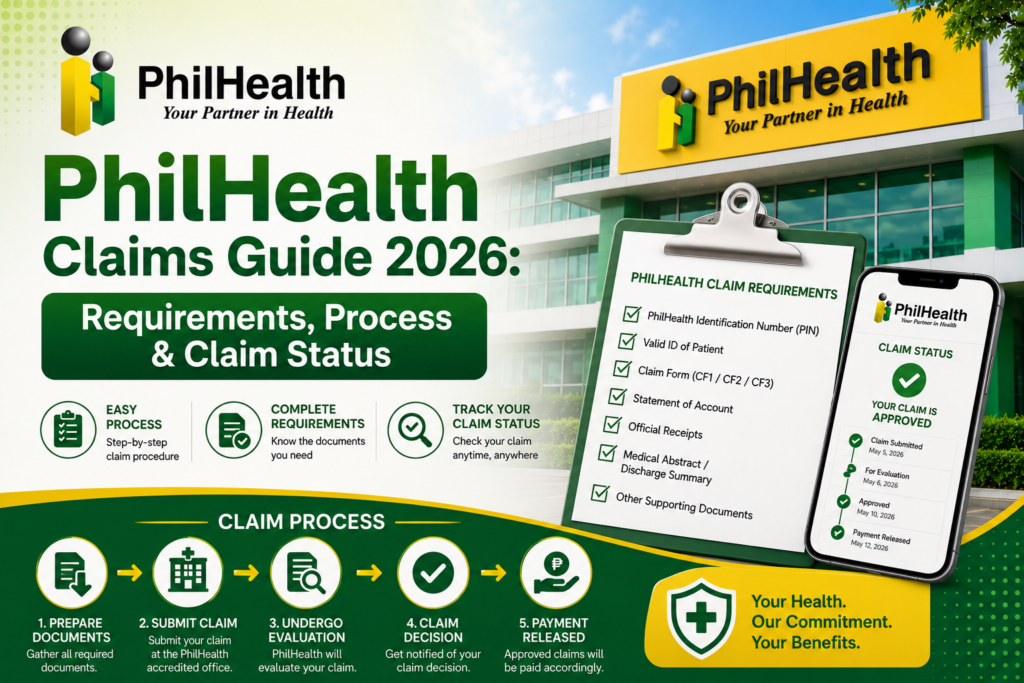
PhilHealth Claims Guide 2026: Requirements, Step-by-Step Process & How to Check Your Claim Status
What Are PhilHealth Claims?
A PhilHealth claim is a formal request submitted to the Philippine Health Insurance Corporation to pay a predetermined amount — called the case rate benefit — directly to an accredited healthcare provider for covered medical services rendered to a member or their qualified dependent. When you file a PhilHealth claim, you are essentially asking PhilHealth to fulfill its obligation under the National Health Insurance Program and apply the benefit to reduce your hospital bill. The claim documents the diagnosis, the procedures performed, and the member’s eligibility to receive PhilHealth benefits.
Think of a claim as the bridge between your PhilHealth membership and the actual financial assistance you receive during a medical event. Without a properly filed claim, even an active member with updated contributions will not receive the benefit deduction.
Who Can File a PhilHealth Claim?
PhilHealth claims can be filed by any active PhilHealth member who meets the eligibility requirements. Additionally, claims can be filed on behalf of qualified dependents — including the legal spouse, children under 21 years old, and dependent parents over 60. In practice, the hospital or healthcare provider typically initiates and processes the claim on the member’s behalf. The member’s role is to declare their membership upon admission, present the required documents, and sign the claim form. In special circumstances where the hospital does not file, the member may need to file a reimbursement claim directly at a PhilHealth branch.
Eligibility Requirements for PhilHealth Claims
Before a PhilHealth claim can be processed, you must meet these core eligibility criteria:
- Active membership status: Your PhilHealth record must show “Active” at the time of confinement or procedure.
- Sufficient contributions: At least three months of premium payments within the six-month period immediately before the month of confinement.
- 45-day limit compliance: You have not yet exhausted the annual 45-day room and board benefit for the current calendar year.
- Accredited facility: The hospital or clinic is PhilHealth-accredited, except in verified emergency situations.
- Accredited physician: The attending doctor is a PhilHealth-accredited professional.
You can verify your eligibility status anytime by logging into the PhilHealth Member Portal and checking your contribution history and membership status.
Types of PhilHealth Claims
PhilHealth claims are generally categorized based on the type of medical service received. The main types are inpatient claims, outpatient claims, and direct reimbursement claims. Each type has specific documentation requirements and filing procedures.
Inpatient PhilHealth Claims
Inpatient PhilHealth claims are the most common type. They apply when a member is admitted to an accredited hospital for at least 24 hours. Covered services include room and board, medications, laboratory tests, operating room fees, and professional fees — all bundled into a case rate amount for the specific illness or procedure. The hospital files the claim electronically through PhilHealth’s claims processing system. The member simply presents their PhilHealth ID or Member Data Record (MDR) and a valid ID upon admission.
Outpatient PhilHealth Claims
Outpatient PhilHealth claims cover day surgeries, chemotherapy, radiotherapy, hemodialysis sessions, and other procedures that do not require overnight hospital stays. Like inpatient claims, these are usually processed by the accredited facility. The case rate benefit for outpatient procedures is applied as a deduction from the total cost of the specific treatment. Hemodialysis patients, for instance, receive a per-session deduction at their accredited dialysis center, up to 156 sessions annually.
Reimbursement Claims
Direct reimbursement PhilHealth claims are filed when a member pays the full hospital bill out of pocket — usually because the claim was not processed during admission or the facility was non-accredited but was the nearest available during an emergency. The member must gather all original receipts, medical records, and the completed claim form, then personally submit these at a PhilHealth branch. Reimbursement claims involve a longer processing period and stricter documentation review. Whenever possible, file your claim upon admission to benefit from automatic deduction and avoid the reimbursement route.
Required Documents for PhilHealth Claims
Having the correct PhilHealth requirements ready is essential for a smooth claim process. Here is what you need to present:
- PhilHealth ID or Member Data Record (MDR): A printed or digital copy of your latest MDR is acceptable. Download it from the Member Portal.
- One valid government-issued ID: Philippine National ID, passport, UMID, driver’s license, or any accepted primary ID. See our PhilHealth Requirements page for the full list.
- PhilHealth Claim Form: Provided by the hospital’s billing section. Review and sign it carefully.
- Proof of relationship (if claiming for a dependent): Marriage certificate for spouse, birth certificate for children.
- Clinical records (for reimbursement claims): Medical abstract, final bill, official receipts, and doctor’s certification.
How to File a PhilHealth Claim (Step-by-Step)
Step 1: Declare Your Membership Upon Admission
This is the most critical step. At the hospital admissions or billing counter, immediately inform the officer that you are a PhilHealth member and intend to avail of your benefits. Do not wait until discharge.
Step 2: Present Your PhilHealth Documents
Show your PhilHealth ID or printed MDR along with your valid government ID. If claiming for a dependent, present the proof of relationship document as well.
Step 3: Complete and Sign the Claim Form
The hospital billing staff will provide the PhilHealth Claim Form. Check that your personal details, diagnosis, and membership information are correctly filled out before signing. Your signature authorizes PhilHealth to process the benefit deduction.
Step 4: Hospital Processes the Claim
The hospital’s PhilHealth section transmits the claim electronically to PhilHealth for validation. They verify your contribution status and eligibility in real time through PhilHealth’s online system.
Step 5: Receive the Benefit Deduction Upon Discharge
When you are discharged, your final billing statement will reflect the PhilHealth case rate deduction. You pay only the remaining balance. Review the bill to confirm the deduction is applied correctly.
Hospital Filing vs Member Filing
In the vast majority of cases, the accredited hospital files the PhilHealth claim on the member’s behalf. This is the standard and most convenient method — the hospital and PhilHealth communicate directly, and the benefit deduction appears automatically on your final bill. Member filing, or direct reimbursement, is the fallback option when the hospital cannot or did not file the claim. Member filing requires significantly more paperwork and patience. Always aim for hospital filing by declaring your membership early and presenting complete documents.
Claiming PhilHealth Benefits for Dependents
Your qualified dependents are entitled to the same PhilHealth benefits as you are. When a dependent is hospitalized, the claim process is identical, but you must present additional proof of relationship. The dependent’s eligibility is tied to your membership status — if your contributions are updated, your dependent can claim benefits. Remember that dependents share your 45-day annual room and board limit. Ensure all dependents are properly listed on your Member Data Record well before any medical event.
How PhilHealth Claims Are Processed
Once the hospital submits your PhilHealth claim electronically, PhilHealth’s system validates your membership status, contribution history, and the medical case rate applicable to your diagnosis. The system checks your eligibility in real time. For valid claims, PhilHealth approves the case rate amount and the hospital deducts it from your bill. The hospital later receives the corresponding payment from PhilHealth. This entire process happens behind the scenes — the member’s primary interaction is at admission and discharge.
How to Check PhilHealth Claim Status
For hospital-filed claims, your claim status is effectively confirmed when you see the deduction on your final bill. To verify that the claim was properly recorded in your membership history, log in to the PhilHealth Member Portal. Navigate to your contribution and claims history section. If you filed a direct reimbursement claim at a PhilHealth branch, request a reference or tracking number and follow up with the same branch. Processing updates for reimbursement claims are typically provided at the branch where you filed.
PhilHealth Claim Processing Times
For hospital-filed PhilHealth claims, the deduction is immediate — it appears on your final bill upon discharge. The electronic validation with PhilHealth’s database happens during your confinement. For direct reimbursement claims filed personally at a branch, processing takes longer because each document is manually reviewed. The exact timeframe depends on the completeness of your submission, the complexity of the medical case, and the current volume of claims at the processing office. Always submit complete documents to minimize delays.
Common Reasons PhilHealth Claims Are Denied
- Insufficient contributions: Fewer than three months of payments in the six months before confinement.
- Inactive membership status: Contributions have lapsed and membership is not current.
- 45-day limit exhausted: The member has already used the maximum room and board benefit for the year.
- Non-accredited facility: The hospital is not PhilHealth-accredited and the situation was not a verified emergency.
- Name discrepancies: The name on the claim form does not match PhilHealth records exactly.
- Incomplete documentation: Missing signatures, unsigned claim forms, or absent supporting documents.
If your claim is denied, ask the hospital billing section for the specific reason. Many denials can be corrected and resubmitted. Do not leave the hospital without understanding why your claim was not processed.
How to Avoid PhilHealth Claim Delays and Denials
- Verify your contribution status through the Member Portal at least one month before any planned procedure.
- Download and print a fresh MDR to bring to the hospital.
- Declare your PhilHealth membership at the admissions desk immediately — never wait until discharge.
- Double-check that your name on the claim form matches your government ID exactly.
- If claiming for a dependent, bring the original and a photocopy of the proof of relationship document.
- Keep your own copy of all signed claim forms and the final hospital bill showing the PhilHealth deduction.
Practical Tips for a Smooth PhilHealth Claim Experience
- Save a digital copy of your MDR on your phone as a backup.
- Know your PIN by heart or store it securely on your phone.
- If you are scheduled for a planned surgery, verify your eligibility with PhilHealth beforehand.
- During emergencies, even non-accredited facilities can be covered — inform the hospital and follow up with PhilHealth afterward.
- Keep all original receipts and documents organized in an envelope during your hospital stay.
PhilHealth Claims Comparison Table
| Claim Type | Where Filed | Who Files | Deduction Timing | Key Documents |
|---|---|---|---|---|
| Inpatient | Accredited hospital | Hospital billing section | Upon discharge | PhilHealth ID/MDR, valid ID, claim form |
| Outpatient | Accredited clinic/hospital | Facility billing section | Upon service | PhilHealth ID/MDR, valid ID, claim form |
| Reimbursement | PhilHealth branch | Member personally | After branch processing | Receipts, medical abstract, claim form, ID |
Frequently Asked Questions About PhilHealth Claims
Can I file a PhilHealth claim if I am unemployed but was previously contributing?
If you have at least three months of contributions within the six-month period before confinement, you may still be eligible to file a PhilHealth claim even if you are currently unemployed. The key is whether your contributions were recently updated. Check your status through the Member Portal or at a PhilHealth branch before a planned procedure.
Does PhilHealth cover the entire hospital bill?
No. PhilHealth applies a fixed case rate deduction based on the specific illness or procedure. This covers a significant portion but not always 100% of your bill. Any remaining balance after the PhilHealth deduction and other discounts (like senior citizen discount) is your responsibility.
What if the hospital refuses to file my PhilHealth claim?
If you are eligible and the hospital is accredited, they are obligated to process your PhilHealth claim. Politely ask for the specific reason for refusal. If unresolved, request to speak with the hospital’s PhilHealth officer. You can also contact PhilHealth’s customer service or visit a branch for assistance.
Can I claim PhilHealth benefits for a deceased member?
Yes. The PhilHealth claim for a deceased member’s final hospital confinement can be filed by the next of kin. Present the member’s PhilHealth ID or MDR, valid IDs, death certificate, and proof of relationship. The hospital or the branch can guide you through the specific requirements.
How many times can I claim PhilHealth benefits in a year?
There is no limit on the number of PhilHealth claims you can file in a year. However, the room and board benefit is capped at 45 days per calendar year. Once exhausted, other components of the bill like drugs and professional fees are still covered.
Key Takeaways About PhilHealth Claims
- File your PhilHealth claim upon hospital admission — not at discharge — by informing the billing desk and presenting your PhilHealth ID or MDR and a valid ID.
- You need at least three months of contributions within the last six months and an active membership status to be eligible for claims.
- Hospital-filed claims result in automatic deduction from your bill. Reimbursement claims are filed personally at a PhilHealth branch after paying the bill.
- Common denial reasons include insufficient contributions, inactive status, and name discrepancies on claim forms.
- Claim procedures and requirements may change. Always verify current policies through the official PhilHealth website at www.philhealth.gov.ph or at a PhilHealth branch.
Image Recommendations for This Article
- Filename: philhealth-claims-filing-process-hospital.jpg
ALT: Patient presenting PhilHealth ID and MDR at hospital admissions desk to file a PhilHealth claim.
Title: Filing PhilHealth Claim at Hospital
Caption: Always declare your PhilHealth membership upon hospital admission to file your claim correctly. - Filename: philhealth-claim-form-sample-document.jpg
ALT: Sample PhilHealth Claim Form showing member information and signature section.
Title: PhilHealth Claim Form Sample
Caption: The PhilHealth Claim Form provided by the hospital billing section for member signature. - Filename: philhealth-claim-deduction-hospital-bill.jpg
ALT: Final hospital bill showing PhilHealth case rate deduction applied before total amount due.
Title: PhilHealth Claim Deduction on Bill
Caption: The PhilHealth benefit deduction reflected on the final hospital billing statement. - Filename: philhealth-claim-status-check-portal.jpg
ALT: Member checking PhilHealth claim status and contribution history on the Member Portal dashboard.
Title: Check PhilHealth Claim Status Online
Caption: Verify your claim history and membership status through the PhilHealth Member Portal.
Disclaimer
This website (philhealth-portal.ph) is an independent informational resource and is not affiliated with PhilHealth, the Philippine Health Insurance Corporation, or the Philippine Government. PhilHealth claims procedures, required documents, case rates, and processing policies are subject to change through PhilHealth circulars. This guide provides general information based on publicly available resources. Always verify current claim requirements and processes through the official PhilHealth website at www.philhealth.gov.ph or at a PhilHealth branch.
Need More Help?
Explore our comprehensive PhilHealth Online Registration Guide for step-by-step instructions.
View Registration Guide →