Quick Summary
- Who this guide is for: Filipino citizens, OFWs, and foreigners seeking PhilHealth membership or updates.
- Important Notes: Always prepare valid IDs and correct forms before proceeding.
- Estimated Time: 23 minutes for reading and preparation.
PhilHealth Maternity Benefits 2026: Complete Eligibility, Coverage, and How to Claim
What Are PhilHealth Maternity Benefits?
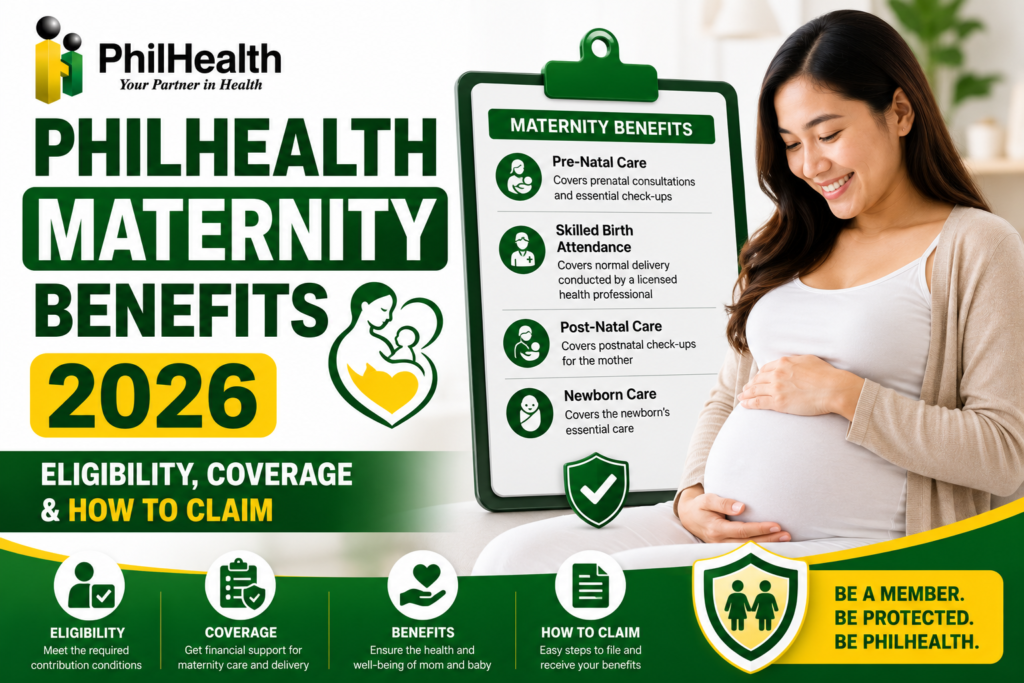
PhilHealth maternity benefits are the health insurance coverage provided by the Philippine Health Insurance Corporation for pregnancy-related medical services. These benefits are delivered through a fixed case rate payment system — PhilHealth pays a predetermined amount directly to the accredited hospital or birthing center, which is then deducted from the patient’s total bill. The maternity package covers the mother’s delivery — whether normal spontaneous delivery or cesarean section — as well as prenatal care and newborn care services including newborn screening. The benefit aims to make childbirth safer and more affordable for Filipino families by significantly reducing out-of-pocket hospital expenses. Both the mother and the newborn are covered under this package, ensuring that the critical first days of life receive financial support.
Who Is Eligible for PhilHealth Maternity Benefits?
- Female PhilHealth members who are active and meet contribution requirements.
- Dependent spouses of male PhilHealth members — the wife must be properly declared as a dependent on the husband’s membership record.
- Employed, voluntary, self-employed, and OFW members all qualify, provided contribution requirements are met.
- Sponsored members (indigent, 4Ps beneficiaries) are also eligible.
Eligibility hinges on two factors: active membership status and sufficient contributions. For more on membership categories, see our PhilHealth membership guide.
Contribution Requirements for Maternity Claims
The most critical eligibility rule: you must have at least three months of PhilHealth contributions within the six-month period immediately before the month of delivery. For example, if you give birth in August, you need at least three contribution payments from February through July. This applies whether you are an employed member whose contributions are remitted by your employer, or a voluntary member paying your own premiums. Contributions must be posted in PhilHealth’s system — deductions on your payslip are not enough if the employer has not actually remitted them. I strongly recommend checking your contribution history through the Member Portal at the start of your third trimester. This gives you time to fill any gaps before delivery. For contribution rates, consult the PhilHealth Contribution Table.
Direct vs Indirect Contributors: Maternity Benefit Eligibility
| Contributor Type | Who Pays Premiums | Maternity Benefit Eligibility |
|---|---|---|
| Direct (Employed, Self-Employed, Voluntary, OFW) | Member and/or employer | Yes — must meet 3-month contribution rule |
| Indirect (Sponsored, Indigent, 4Ps) | Government subsidy | Yes — covered as long as sponsorship is active |
Maternity Benefits for Employed Members
Employed female members qualify for PhilHealth maternity benefits as long as their employer has been regularly remitting contributions. The employee’s share is deducted from her salary, and the employer adds the counterpart share. Before maternity leave begins, verify your contribution history through the Member Portal. If you discover missing contributions, immediately notify your HR department so they can settle any unremitted payments before your delivery date. The employer is legally obligated to remit contributions on time. For employed members, the maternity benefit claim is filed at the hospital — the deduction is applied directly to the bill.
Maternity Benefits for Voluntary and Self-Employed Members
Voluntary and self-employed members who pay their own PhilHealth contributions are fully entitled to maternity benefits. The key is ensuring your payments are up to date. Since you manage your own contributions, schedule your quarterly or semi-annual payments so that at least three months are covered within the six-month window before your expected delivery month. Do not wait until the last trimester to catch up — make consistent payments throughout your pregnancy. Check your contribution history after each payment to confirm posting. For payment options, see our guides on voluntary contributions and paying via GCash.
Maternity Benefits for OFW Members
Overseas Filipino Workers who are active PhilHealth members can claim maternity benefits. If the OFW herself is giving birth in the Philippines, the standard eligibility rules apply — at least three months of contributions. If the OFW is male and his dependent spouse is giving birth, the spouse can claim under the OFW’s membership, provided she is properly declared as a dependent and the OFW’s annual contributions are paid. The family in the Philippines should have a copy of the OFW’s updated Member Data Record for hospital presentation. For complete OFW guidance, visit our PhilHealth OFW guide.
Maternity Benefits for Sponsored and Indigent Members
Sponsored members — including indigent families identified through the DSWD Listahanan and 4Ps beneficiaries — are entitled to PhilHealth maternity benefits. Their premiums are fully subsidized by the government, so contribution requirements are automatically met as long as their sponsorship status remains active. Sponsored members should verify their active status before delivery by checking with their local social welfare office or visiting a PhilHealth branch. The maternity claim process is the same as for other member types.
Special Cases: Maternity Benefits for Senior Citizens
While maternity benefits are not directly applicable to senior citizens themselves, a unique scenario exists: if a senior citizen male member has a dependent spouse of childbearing age properly declared on his PhilHealth record, that spouse can claim maternity benefits under the senior’s lifetime membership. The senior’s coverage is active and premium-free, and dependent benefits extend to the qualified spouse. The same contribution requirements do not apply since the senior is a lifetime member — but the spouse must be formally declared as a dependent. For more on senior coverage, see our PhilHealth Senior Citizens guide.
Covered Maternity Services Under PhilHealth
| Service | Coverage Details |
|---|---|
| Prenatal Care | Regular check-ups, laboratory tests, vitamins as part of the maternity package |
| Normal Spontaneous Delivery | Fixed case rate covering delivery room, professional fees, basic medications |
| Cesarean Section | Higher case rate covering surgery, operating room, anesthesia, professional fees |
| Newborn Care | Newborn screening, hearing test, essential newborn interventions |
| Miscarriage Management | Covered under specific case rate for completion curettage |
Prenatal Care Coverage
PhilHealth’s maternity package includes prenatal care services. Regular prenatal check-ups at accredited health facilities are covered. These visits monitor the mother’s and baby’s health throughout pregnancy and help identify potential complications early. Laboratory tests and basic vitamins prescribed during prenatal visits are generally included. To maximize this benefit, register early in your pregnancy at a PhilHealth-accredited health facility or Konsulta provider. For more on primary care, see our PhilHealth Benefits guide.
Normal Spontaneous Delivery Benefits
PhilHealth provides a fixed case rate for normal spontaneous delivery at accredited hospitals and birthing centers. The benefit covers the delivery room fees, professional fees of the attending midwife or doctor, and basic medications used during delivery. The exact case rate amount is set by PhilHealth circulars and may vary based on the facility level — a birthing center, a primary hospital, or a tertiary hospital. The benefit is deducted directly from the total bill upon discharge. To qualify, the delivery must be attended by a PhilHealth-accredited health professional at an accredited facility.
Cesarean Section (CS) Benefits
PhilHealth maternity benefits cover cesarean section deliveries at a higher case rate than normal delivery, reflecting the surgical nature of the procedure. The CS package covers the operating room fees, anesthesia, professional fees of the surgeon and anesthesiologist, and related medications. Both elective cesarean sections (planned in advance) and emergency cesarean sections are covered. The same eligibility rules apply — at least three months of contributions within the six months before delivery. The CS must be performed at a PhilHealth-accredited hospital with accredited physicians.
Newborn Care Benefits
The PhilHealth newborn care package is a vital component of maternity benefits. It covers newborn screening — a simple blood test that checks for several congenital disorders that can affect a baby’s long-term health. The package also covers the newborn hearing test and essential newborn interventions performed immediately after birth. The newborn care benefit is processed alongside the mother’s maternity claim at the same facility. Even if complications arise requiring the newborn to be admitted to a neonatal intensive care unit, PhilHealth coverage may apply depending on the specific case rate packages for the newborn’s condition.
Accredited Hospitals and Birthing Centers
To claim PhilHealth maternity benefits, delivery must occur at a PhilHealth-accredited facility. This includes accredited hospitals (primary, secondary, and tertiary levels), accredited birthing centers, and accredited lying-in clinics. Before choosing your delivery facility, verify its accreditation status. You can check through the official PhilHealth website, by calling the PhilHealth hotline, or by asking the facility directly. Some rural health units and government maternity facilities are also accredited. In true emergency situations where the nearest facility is not accredited, PhilHealth may still cover the delivery under emergency care provisions. However, for planned deliveries, always choose an accredited facility to ensure your benefits are processed smoothly.
Maternity Benefit Packages Overview
PhilHealth’s maternity benefits are structured as case rate packages. Each package bundles a set of services into a single fixed payment. The mother’s delivery package and the newborn care package are separate line items but are processed together during the hospital stay. The benefit amount is applied as a deduction from the total hospital bill — you pay only the remaining balance after PhilHealth’s share is subtracted. The exact case rate amounts depend on the type of delivery and the facility level. For current case rates, refer to official PhilHealth circulars or inquire at your chosen accredited facility.
What Expenses May Not Be Covered by PhilHealth Maternity Benefits
- Private room upgrades beyond the standard ward accommodation covered by the case rate.
- Non-essential procedures or elective extras not medically required.
- Professional fees exceeding the case rate allocation — some doctors may charge above the PhilHealth rate.
- Take-home medications and supplies beyond what is used during confinement.
- Delivery at non-accredited facilities for non-emergency situations.
Ask the hospital billing section for a clear breakdown of what the PhilHealth case rate covers and what your expected out-of-pocket balance will be.
Quick Eligibility Checklist for Expectant Mothers
- ☐ Active PhilHealth membership — check your status on the Member Portal
- ☐ At least 3 months of contributions in the 6 months before delivery month
- ☐ Delivery planned at a PhilHealth-accredited facility
- ☐ PhilHealth ID or updated MDR printed and ready
- ☐ Valid government ID
- ☐ Marriage certificate (if claiming as dependent spouse)
Required Documents for Maternity Claims
| Document | Required For |
|---|---|
| PhilHealth ID or MDR | All maternity claims — proof of membership |
| Valid Government ID | Identity verification |
| PhilHealth Claim Form | Provided by hospital; must be signed |
| Marriage Certificate | If claiming as dependent spouse of a male member |
| Birth Certificate (Newborn) | For newborn care package processing |
How to Prepare Before Delivery for a Smooth Maternity Claim
- Verify your contribution history at the start of your third trimester.
- Confirm your chosen facility is PhilHealth-accredited.
- Prepare a maternity folder with your PhilHealth ID or MDR, government ID, marriage certificate (if applicable), and your OB-Gyne’s contact information.
- Discuss PhilHealth coverage with your doctor — ask about professional fees and any potential balance billing.
- Pack your PhilHealth documents in your hospital bag so they are not forgotten in the rush to the delivery room.
How to File a PhilHealth Maternity Claim Step by Step
Step 1: Inform the Hospital Upon Admission
When you arrive at the hospital in labor, immediately tell the admissions or billing officer that you are a PhilHealth member and will be claiming maternity benefits. Do not wait until after delivery or discharge.
Step 2: Present Your PhilHealth Documents
Show your PhilHealth ID or printed Member Data Record and your valid government ID. If claiming as a dependent, present your marriage certificate.
Step 3: Sign the PhilHealth Claim Form
The hospital billing section will provide the PhilHealth Claim Form. Review your personal details, the diagnosis, and the procedure. Sign to authorize PhilHealth to apply the case rate deduction.
Step 4: Receive the Benefit Deduction Upon Discharge
When you are discharged, the hospital bill will reflect the PhilHealth maternity case rate deduction. You pay only the remaining balance. The newborn care package deduction should also appear.
Hospital Filing vs Reimbursement Process
In almost all cases, the maternity claim is filed directly by the accredited hospital — the deduction appears on your final bill. This is the standard and preferred process. In rare situations where you pay the full bill upfront — for example, if the hospital’s PhilHealth system was offline or if you delivered at a non-accredited facility during an emergency — you may need to file a direct reimbursement claim at a PhilHealth branch. Reimbursement requires additional documents: original official receipts, medical abstract, and the completed claim form. Reimbursement processing takes longer than hospital filing. Always aim for hospital filing by ensuring you deliver at an accredited facility and declare your membership upon admission.
Maternity Claim Processing Timelines
For hospital-filed claims, the benefit deduction is immediate — it appears on your final bill upon discharge. The hospital handles the electronic transmission to PhilHealth. For direct reimbursement claims filed at a PhilHealth branch, processing involves manual document review and may take longer. The exact duration depends on the completeness of your documents and the branch’s current volume of claims. Submit complete documents to minimize delays.
How Dependents Are Affected by Maternity Benefits
A dependent spouse of a male PhilHealth member can claim maternity benefits using the principal member’s contributions. The spouse must be properly declared on the member’s PhilHealth record and listed on his MDR. The principal member must meet the three-month contribution requirement. During the claim, the marriage certificate must be presented to prove the relationship. If the spouse is not declared as a dependent, the claim will be denied even if the relationship is legitimate. Check and update dependent records well before the delivery date.
Common Reasons Maternity Claims Are Denied
| Reason | How to Avoid |
|---|---|
| Insufficient contributions | Verify contribution history in third trimester; fill gaps early |
| Dependent spouse not declared | Update dependent records during pregnancy |
| Non-accredited facility | Choose a PhilHealth-accredited hospital or birthing center |
| Name mismatch | Ensure PhilHealth records match your valid ID exactly |
Common Maternity Claim Mistakes to Avoid
- Waiting until the last month to check contribution history — gaps discovered late are harder to fix.
- Not bringing PhilHealth documents to the hospital — keep them in your hospital bag.
- Failing to declare the dependent spouse — an undeclared wife cannot claim, even with a marriage certificate.
- Choosing a non-accredited facility for a planned delivery — verify accreditation before your due date.
- Not informing admissions upon arrival — claims processed at discharge face more complications.
Expert Tips to Maximize Your PhilHealth Maternity Benefits
- Start prenatal care early at a PhilHealth-accredited Konsulta provider to maximize covered services.
- Print multiple copies of your MDR and keep one in your hospital bag, one with your partner, and one at home.
- Discuss professional fees with your OB-Gyne — understand what PhilHealth covers and what may be billed separately.
- If you are a voluntary member, consider paying your contributions annually at the start of pregnancy to ensure continuous coverage.
- After delivery, immediately register your newborn as a dependent on your PhilHealth record for future coverage.
Maternity Benefits Comparison Tables
Normal Delivery vs Cesarean Section Coverage
| Feature | Normal Delivery | Cesarean Section |
|---|---|---|
| Case Rate Amount | Lower fixed rate | Higher fixed rate |
| Covered Services | Delivery room, midwife/doctor PF, basic meds | Operating room, anesthesia, surgeon PF, meds |
| Accredited Facility Required | Yes — hospital or birthing center | Yes — hospital only |
Frequently Asked Questions About PhilHealth Maternity Benefits
Can I claim PhilHealth maternity benefits if I just started contributing?
You need at least three months of contributions within the six months before delivery. If you only started contributing recently and have fewer than three months of payments, you may not qualify. Start paying consistently as early as possible — ideally before pregnancy or during the first trimester.
Does PhilHealth cover home births?
PhilHealth maternity benefits are designed for facility-based deliveries at accredited hospitals, birthing centers, or lying-in clinics. Home births attended by a midwife or doctor generally do not qualify for the full case rate deduction unless specific conditions are met and the birth is reported through proper channels. Deliver at an accredited facility to ensure coverage.
Can I claim maternity benefits twice in one year?
Yes. PhilHealth does not limit the number of maternity claims per year, as long as eligibility requirements are met for each delivery. Each pregnancy is evaluated independently based on contribution records for that specific delivery period.
What if I change jobs during pregnancy — will my maternity benefits be affected?
Your PhilHealth PIN remains the same. Ensure your new employer continues remitting contributions without gaps. Verify your contribution history covers at least three months in the six months before delivery. If gaps occur, consider paying as a voluntary member during the transition.
Does PhilHealth cover complications during pregnancy or delivery?
Yes. Pregnancy-related complications such as pre-eclampsia, ectopic pregnancy, or postpartum hemorrhage are covered under PhilHealth’s case rate packages. The specific case rate depends on the diagnosis and treatment required. These are separate from the standard maternity delivery package.
Key Takeaways
- PhilHealth maternity benefits cover prenatal care, normal delivery, cesarean section, miscarriage management, and newborn care at accredited facilities.
- You need at least three months of contributions within the six months before your delivery month to qualify.
- Always verify your contribution history in your third trimester and fill any gaps before your due date.
- Deliver at a PhilHealth-accredited facility and declare your membership upon admission — not at discharge.
- Maternity benefit packages, case rates, and requirements may change. Always verify through the official PhilHealth website at www.philhealth.gov.ph.
Image Recommendations for This Article
- Filename: philhealth-maternity-benefits-coverage-overview.jpg
ALT: Pregnant woman holding PhilHealth ID and MDR with hospital background representing maternity benefits.
Title: PhilHealth Maternity Benefits Overview
Caption: PhilHealth provides comprehensive maternity benefits for qualified members delivering at accredited facilities. - Filename: philhealth-maternity-claim-documents-checklist.jpg
ALT: Checklist of required documents for PhilHealth maternity claims including MDR, valid ID, and marriage certificate.
Title: Maternity Claim Documents Checklist
Caption: Prepare these documents before delivery for a smooth PhilHealth maternity claim. - Filename: philhealth-normal-delivery-vs-cesarean-benefits.jpg
ALT: Comparison chart showing PhilHealth case rate coverage for normal delivery versus cesarean section.
Title: Normal vs Cesarean Delivery Benefits
Caption: PhilHealth covers both normal and cesarean deliveries with different case rate packages. - Filename: philhealth-newborn-care-screening-benefits.jpg
ALT: Newborn baby receiving PhilHealth-covered newborn screening and hearing test in hospital nursery.
Title: PhilHealth Newborn Care Benefits
Caption: The PhilHealth newborn care package covers newborn screening and essential interventions.
Disclaimer
philhealth-portal.ph is an independent informational website and is not affiliated with the Philippine Health Insurance Corporation (PhilHealth) or the Philippine Government. Maternity benefit packages, eligibility requirements, contribution rules, and claims procedures may change over time. This guide provides general information based on publicly available resources. Always verify important information through official PhilHealth resources at www.philhealth.gov.ph.
Need More Help?
Explore our comprehensive PhilHealth Online Registration Guide for step-by-step instructions.
View Registration Guide →